Simps, Ring Lights and Tip Jars
How Adult Industry Aesthetics Became Pop Culture's Default
Look at almost any phone tonight and you will find a face lit from the front by a soft ring of light, talking straight into the camera, asking to be tipped. The setup reads as neutral now, the ordinary grammar of internet life. It was not invented by wellness coaches or gaming streamers or the person doing a skincare routine at two in the morning. A surprising amount of what we treat as the plain look and language of the creator economy was worked out first inside the paid erotic webcam business and the adult subscription sites that grew up beside it. The ring light, the tip button, the direct address to a stranger, the word "simp", even the soft accusation buried inside tipping culture that someone is paying too much for attention: these are adult industry aesthetics that changed clothes and took a respectable job. None of it is a scandal. It is closer to what happens whenever a stigmatised trade solves a hard problem before anyone reputable is willing to try. The solution travels. The people who found it usually stay behind.
Words carry their history quietly, so start with one. "Simp" sounds like pure Gen Z, but it passed through at least three worlds before it landed in a fourteen-year-old's caption. It lived in West Coast hip hop through the 1980s and 1990s as a put-down for a man who went soft over a woman, a compression of "simpleton" that some later folk-etymologised as the opposite of a pimp. It was picked up and made nastier through the 2010s in the manosphere, the MGTOW subreddits and 4chan boards where male grievance gets rehearsed; by early 2019 one anti-feminist subreddit alone accounted for thousands of the word's appearances that year, and Google recorded interest in the term roughly doubling between late 2018 and late 2019. MEL Magazine documented the drift from those forums toward the mainstream in October 2019, weeks before the term went off. Then TikTok turned it into a joke you could film, the "Simp Nation" clips where a boy does something kind and is sentenced to membership. By the autumn of 2020 there was a "No Simp September", Twitch briefly weighed banning it as an emote, Merriam-Webster added it to the dictionary in 2021, and an Australian member of parliament used it about the prime minister on live television. Somewhere in that noise the word softened into a tease people happily aim at themselves, for their pets and their crushes and their favourite bands.
What the meme buried is the place where the word did its most honest work, which was Twitch. There a simp had a precise definition: a man who hands large sums to a female streamer he will never meet. Take the mockery out and the insult is a folk theory of the entire tipping relationship. It names the exchange that sits under live streaming, paid attention travelling one way and performed warmth travelling back, and then it aims the shame at the man paying while leaving the platform skimming the transaction untouched. Notice who the word never blames: not the company taking its cut, not the model that meters attention like a utility, only the customer. The word did the platforms a quiet favour. It turned a labour arrangement into a character flaw.
The tipping has an even plainer paper trail. OnlyFans, now a shorthand for the whole idea of selling closeness online, launched in 2016 calling itself a "tip jar for bloggers". The tip jar was not a stray phrase. Pay-per-message, the locked post you open for a few dollars, the menu of small paid favours, the token you buy in bulk and spend on a performer: that machinery had been refined for years on cam sites such as LiveJasmin, Chaturbate and MyFreeCams before Twitch shipped its Bits or TikTok sold its Coins. The sociologist Angela Jones spent five years inside that world for her 2020 book Camming. She tracked how models earn through tokens while the platforms and the agencies that coach them take a share of the takings that commonly runs between 40 and 70 per cent. She describes a ranked, gamified marketplace with a visible score that climbs the longer a performer keeps viewers in the room. She also documents the parts nobody chose to borrow: capping, the illegal recording and resale of a private show, and doxing, the exposure of a performer's real name to punish or extort her. Set her account of the token economy beside any mainstream live-streaming app and the family resemblance is hard to miss; the gifts just have cuter names. Twitch introduced its Bits in 2016, and TikTok now sells Coins that a viewer spends on on-screen Gifts, which convert into Diamonds a creator can cash out. The plumbing was second-hand by the time it looked native to a general audience.
From cam room to Zoom call
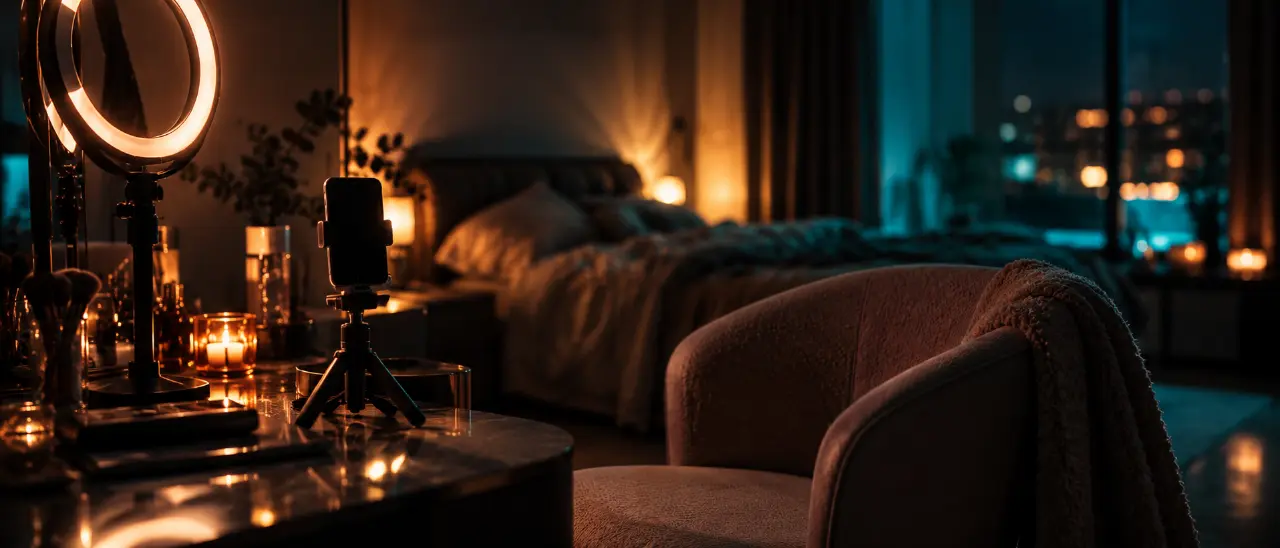
The look took the same road. A ring light does one job well: it wraps a face in even, shadowless, mildly flattering light and leaves a bright circle floating in each eye. Photographers called them beauty lights or glamour lights long before broadband, and they became standard issue in cam rooms because they make skin read smooth through a cheap sensor. The glow then spread to beauty vloggers, then to every teenager filming a lip sync, and then, through the shut-in months of 2020, onto the desks of solicitors and schoolteachers who had never once considered their own lighting. That circular catchlight, which used to signal a certain kind of bedroom broadcast, now signals a work call. The framing came along with the light. The head-and-shoulders confessional, the bed or the softly furnished corner just legible behind the speaker, the camera set a little above the eye line and angled down: that is boudoir grammar, sanded down and made general purpose. Add the soft-focus skin, the warm key, the beauty filter that started life smoothing a performer's complexion for paying strangers, and the aesthetic is complete. The "get ready with me" video films a person at their mirror in the same register a cam model uses to warm up a room before the paid part begins. "Thirst trap", which Urban Dictionary logged as far back as 2011, stopped being an accusation and hardened into a content category that personal trainers and actors and perfectly ordinary people now pencil into their posting schedule.
The catchlight is the giveaway. Two little rings burning in the pupils, the fingerprint of a lamp built to sell a face.
The realness business
Under the lighting and the tip buttons sits the thing the mainstream copied most completely, which is the actual product. The sociologist Elizabeth Bernstein, studying commercial sex a decade before OnlyFans existed, gave it a name in her 2007 book Temporarily Yours: bounded authenticity. Her argument was that many clients are not buying a mechanical act but a genuine-feeling emotional connection that both sides know to be paid for, time-limited, and real enough to matter regardless. Her cases were escorts selling the "girlfriend experience", yet the phrase describes a Twitch subscription just as well. That is now a fair description of most of the creator economy. The "close friends" list, the reply that feels personal, the streamer who clocks your username in the chat, the low hum of knowing someone who does not know you back: creators sell manufactured closeness and audiences buy it while understanding it is manufactured. Jones found cam models performing precisely this labour, the attentiveness and the remembered detail and the warmth on demand, and being worn down by it. More recent research on webcam platforms describes a specific trap that came with the format: once the connection is meant to feel real and continuous, the working day stops having edges, and the free reply at midnight becomes part of the job. The lifestyle influencer clearing her messages at one in the morning and the cam model answering a paying regular's chat for free to keep him around are doing the paid and unpaid halves of the same job.
Twitch is where you can watch the two worlds bicker in the open. In 2021 came the "hot tub meta", streamers broadcasting from paddling pools in swimwear while they chatted and collected tips, and the platform spent months unable to decide whether this counted as allowed. The whole thing played out in "Just Chatting", the category that quietly became the site's crossover zone, where the game is the person. Kaitlyn Siragusa, who streams as Amouranth, would write a viewer's name on her skin for fifty dollars and pulled in thousands of new subscribers doing it, right up until Twitch quietly pulled advertising from her channel without a word of warning. The hot tub gave way to a yoga-pants meta, then to a green-screen trick that keyed out everything but a cropped slice of the streamer's own body, a bit popularised by a streamer called Morgpie and copied within days. The researcher CJ Reynolds has written about these metas as a slow negotiation over what a platform will tolerate, and one finding from that work stays with me: some of the fiercest critics were the streamers' own paying viewers, who argued the streams ran on a parasocial imbalance, that a lonely man tipping a woman he believes he knows is being worked in a way he cannot see. That is the camgirl critique word for word, pointed straight at a site that spent years insisting it was for gamers.
The money kept settling the argument. OnlyFans took in around 7.2 billion dollars in gross revenue in 2024 and passed roughly 5.8 billion of it to creators. It ran the whole operation with something like 46 employees, according to filings by its parent company Fenix International. The trajectory is the tell: revenue doubled to about 375 million dollars in 2020 as venues closed during the pandemic, jumped 118 per cent the following year, and by 2024 the platform counted 4.6 million creator accounts against 377 million fan accounts. Its owner, Leonid Radvinsky, has drawn close to 1.8 billion dollars in dividends since 2021 and has reportedly been shopping the company at a valuation near 8 billion. A business that size does not sit in the corner. It built a safe-for-work streaming service, signed partnerships with sports organisations, recruited comedians such as Whitney Cummings, and started talking about "genres", a plural that politely avoided naming the one that pays for everything. The name became a verb. Bella Thorne and Cardi B opened accounts. "Spicy" arrived as the acceptable label for the same content, relabelled. The format went to the party; the workers who built it waited outside.
The case for treating all of this as an industry rather than a mood becomes obvious the second the money is threatened. In August 2021 OnlyFans announced it would ban sexually explicit content, blamed its banks, and reversed the decision eight days later after a revolt from its creators. Its founder, Tim Stokely, named JPMorgan, Bank of New York Mellon and Britain's Metro Bank as institutions that made the business hard to run; part of what defused the standoff was the company pointing out how much money it moved, on the order of 300 million dollars in payouts a month. Visa and Mastercard had already cut cards off from Pornhub, American Express refuses adult sites outright, and Stripe will not process the content at all. When the ban looked real, a crop of rival platforms sprang up overnight to poach the fleeing creators, which tells you how thin the ground is under anyone building a livelihood there. The performers whose lighting and vocabulary everyone else borrowed can have their income switched off by a compliance officer's note about reputational risk, and regularly have been, a pressure that only tightened after the 2018 American law known as FOSTA left platforms newly frightened of hosting them. That is the underside of the aesthetic. The ring light is cheap and perfectly legal. The labour it was built to flatter sits one bank memo from vanishing.
There is a pattern in who is allowed to make the crossing. A pop star can borrow the choreography of a strip club for an awards show and be praised for her nerve, while the dancer who spent years on that choreography still cannot open an ordinary business account. A skincare brand can shoot a campaign in soft-lit boudoir style and file it under body positivity, while a woman doing the identical thing for rent on a subscription site stays unemployable in half the professions that would happily hire her twin. A daytime host can interview a former adult performer about her "pivot" to wellness while the women who did not pivot are still a punchline. The tools read as edgy and modern when someone with existing status picks them up, and as evidence of a life gone wrong when the person carrying them actually needs the money. This is the oldest manoeuvre in the history of taste, respectable culture feeding on its own margins while keeping those margins at arm's length, and the shoppers and scrollers are not its villains. Most people reaching for a ring light or timing a flattering selfie are just trying to be seen inside a system that pays attention to being seen. They inherited the codes without the invoice.
The neat version of this story has the mainstream cleaning up something disreputable, and it gets one thing exactly backwards. Nothing was cleaned. A light, a button, a word, a way of performing intimacy for strangers who pay: these were only ever tools, made sharp and legible because a stigmatised workforce had every reason in the world to make them sharp and legible. Pop culture kept the tools and sent the shame back down the line. Your accountant's ring light has no idea where it came from. The economy it lights up remembers perfectly well.